Summary
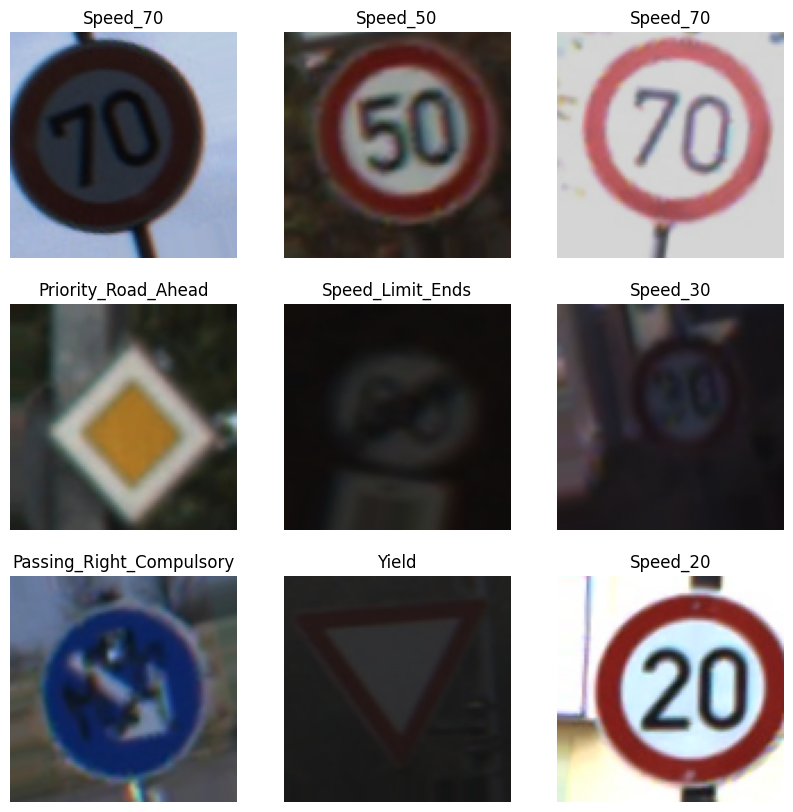
For a self-driving car scenario, I trained a convolutional neural network to recognize 43 classes of traffic signs from about 39,000 labeled images. The data came from the German Traffic Sign Recognition Benchmark.
| Metric | Result |
|---|---|
| Training images / validation images | 31,368 / 7,841 |
| Training accuracy (epoch 11) | 95% |
| Validation accuracy (epoch 10) | 88% |
| Parameters | 1.87 million |
Approach
- Augmentation: random rotation (±15°), shifts, shear, zoom, and a custom HSV brightness adjustment. These simulate signs seen at different angles and in different lighting.
- Architecture: three convolutional layers (32 → 64 → 64 filters) with max pooling, then a dense layer with a 43-way softmax output.
- Pipeline: Keras
ImageDataGeneratorstreams images from disk with an 80/20 train/validation split, and the trained model predicts the holdout set for competition scoring.
model = models.Sequential([
    layers.Conv2D(32, (3, 3), activation='relu', input_shape=(100, 100, 3)),
    layers.MaxPooling2D((2, 2)),
    layers.Conv2D(64, (3, 3), activation='relu'),
    layers.MaxPooling2D((2, 2)),
    layers.Conv2D(64, (3, 3), activation='relu'),
    layers.Flatten(),
    layers.Dense(64, activation='relu'),
    layers.Dense(43, activation='softmax'),
])
Lessons learned
When I stopped training early, the saved model collapsed to predicting a single class on the holdout set. The cause was a loss-function mismatch: from_logits=True combined with a softmax output layer. The fix is to compile with from_logits=False and add an EarlyStopping callback that restores the best weights. Tracking that down taught me to check a model’s prediction distribution, not just its accuracy, before submitting.